Lithium-Sulfur Batteries: A New Horizon in Energy Storage and Their Challenging Journey
An in-depth understanding of the science and obstacles of Lithium-Sulfur technology, which offers manifold higher capacity and lower cost than current Lithium-ion batteries.

In today's era of electric vehicles and smartphones, energy storage is the biggest challenge. The lithium-ion batteries we currently use are reaching their limits. In this situation, scientists' attention has turned toward lithium-sulfur (Lithium-sulfur or Li-S) batteries. These batteries are not only lightweight, but they also have the capacity to store much more energy than lithium-ion cells. The low atomic weight of lithium and the moderate atomic weight of sulfur give this battery a water-like density, making it extremely light in weight. According to Wikipedia and other news sources, the energy density in lithium-sulfur batteries is so high that they could replace lithium-ion in the future.
The history of the lithium-sulfur battery is quite old. It was invented in the 1960s by Herbert and Ulam. They patented a primary battery using a lithium anode and a sulfur cathode. By the late 1980s, a rechargeable lithium-sulfur battery was demonstrated using an ether-based electrolyte. The potential of this technology can be gauged from the fact that in August 2008, a solar-powered unmanned aircraft named 'Zephyr 6' made the longest and highest-altitude flight, which used a lithium-sulfur battery.
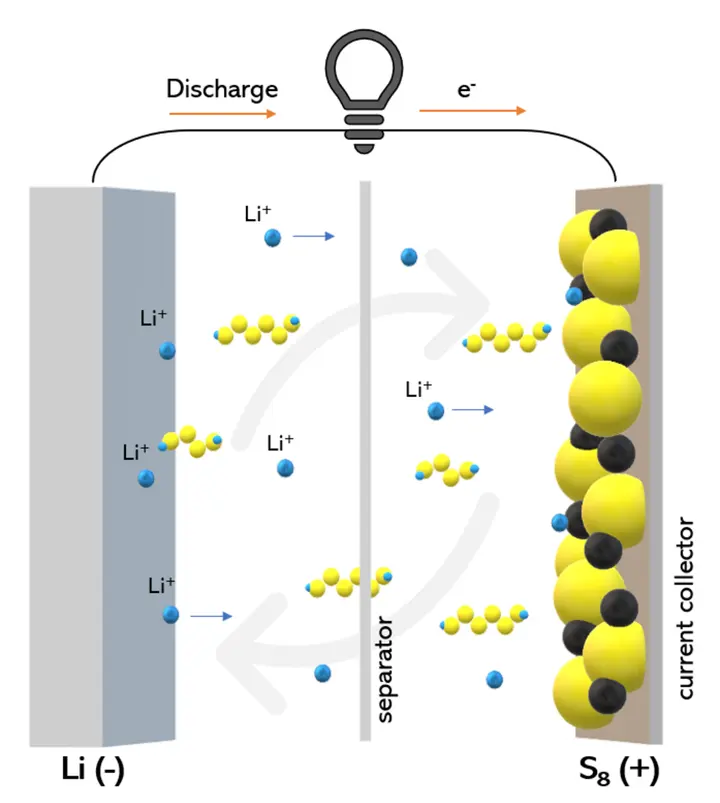
- Oxidation of lithiumMetallic lithium at the anode releases electrons and forms lithium ions (Li+).
- Migration of ionsReleased lithium ions travel through the electrolyte towards the cathode.
- Reduction of sulfurSulfur (S8) at the cathode combines with lithium ions to form various polysulfides (Li2Sx).
- Final productAt the end of the process, lithium sulfide (Li2S) is formed and complete energy is released.
To understand the working mechanism of this battery, we have to look at its chemical structure. In a lithium-sulfur battery, metallic lithium is used as the anode, while sulfur (S8) serves as the cathode. When the battery discharges, lithium dissolves from the surface of the anode and releases electrons. This process is called oxidation. On the other side, sulfur at the cathode combines with these lithium ions to form lithium sulfide (Li2S). During this process, energy is released which we utilize. During charging, this process is reversed and lithium is deposited back onto the anode.
The greatest feature of the lithium-sulfur battery is its storage capacity. In traditional lithium-ion batteries, lithium ions intercalate into the structure of the anode and cathode, where only 0.5 to 0.7 lithium ions can be accommodated per host atom. In contrast, in a lithium-sulfur battery, each sulfur atom can accommodate two lithium ions. Because of this, its theoretical specific energy is approximately 2600 Wh/kg. However, practically a capacity of up to 400-450 Wh/kg has been achieved so far, which is still much higher than that of lithium-ion.
Ah/kg
However, there are several serious technical challenges behind this technology not being available on a wide scale. The biggest challenge is the 'polysulfide shuttle' effect. During discharge, sulfur does not convert directly into lithium sulfide, but passes through intermediate stages known as lithium polysulfides (Li2Sx). These polysulfides dissolve in the electrolyte and leak from the cathode towards the anode. There they react again and return towards the cathode. Due to this continuous process, the active material in the cathode keeps depleting, which reduces the battery's lifespan and causes it to discharge quickly.
The second major obstacle is the low conductivity of sulfur. Sulfur is naturally an insulating material, so conductive substances like carbon must be added to it to facilitate the flow of electricity. Furthermore, when sulfur reacts with lithium, its volume increases by approximately 80%. This change in volume exerts heavy mechanical stress on the cathode, which damages the internal parts of the battery and breaks the contact between carbon and sulfur. To solve these problems, scientists are researching carbon nanofibers and special types of coatings.
The electrolyte also plays an important role in these batteries. The common carbonate-based electrolytes used in lithium-ion batteries do not work here because they react with polysulfides and damage the battery. Instead, special ether-based electrolytes are used. Currently, scientists are also working on solid-state electrolytes, which can completely prevent the polysulfide shuttle effect. NASA is currently running a project named 'SABERS', which is developing solid-state lithium-sulfur batteries for electric aircraft and spacecraft.
| Parameter | Required Target |
|---|---|
| Sulfur Loading | > 5 mg/cm2 |
| Carbon Content | < 5% |
| Electrolyte-Sulfur Ratio (E/S Ratio) | < 5 μL/mg |
| Theoretical Specific Energy | ~ 2600 Wh/kg |
Certain specific targets have been set to make lithium-sulfur batteries commercially successful. According to company announcements and research, the sulfur content in the cathode should be greater than 5 mg/cm2 and the carbon content should be less than 5%. In addition, it is also necessary to keep the electrolyte-to-sulfur ratio (E/S ratio) limited. Only if these criteria are met can the cost of the battery remain low and its efficiency high. In 2017, a battery with 1,500 charge-discharge cycles was demonstrated, but its commercial-scale testing is still pending.

Lithium-sulfur batteries can prove to be extremely important for a country like India. Sulfur is a very inexpensive and abundantly available substance, which can bring about a major reduction in the cost of batteries. If this technology succeeds, the range of electric vehicles could become double of what it is now and their price could become comparable to ordinary petrol vehicles. However, further research is still needed to find permanent solutions to problems such as polysulfide shuttles and volumetric expansion. In the coming decade, we may perhaps see the end of the lithium-ion era and the beginning of the lithium-sulfur era.