Project 18A: India's Naval Revolution and the Rs 80,000 Crore Next-Generation Stealth Destroyers
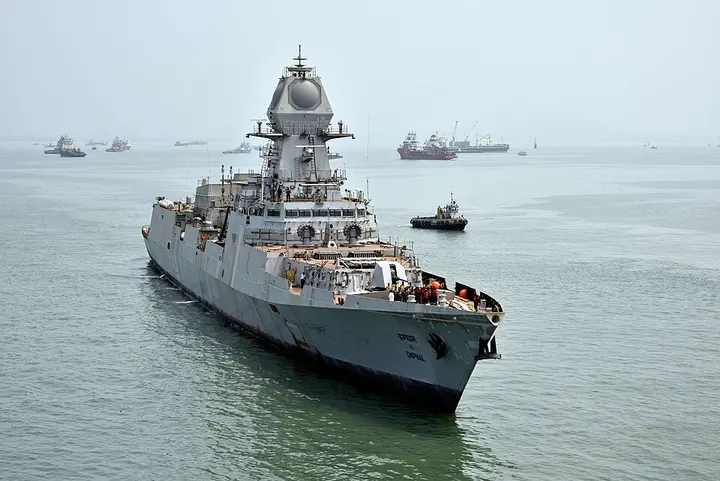
The Indian Navy has taken a major step toward building state-of-the-art stealth guided-missile destroyers to enhance its power in the Indo-Pacific region.
Indian Navy's Project 18A: What Happened and Why It Matters
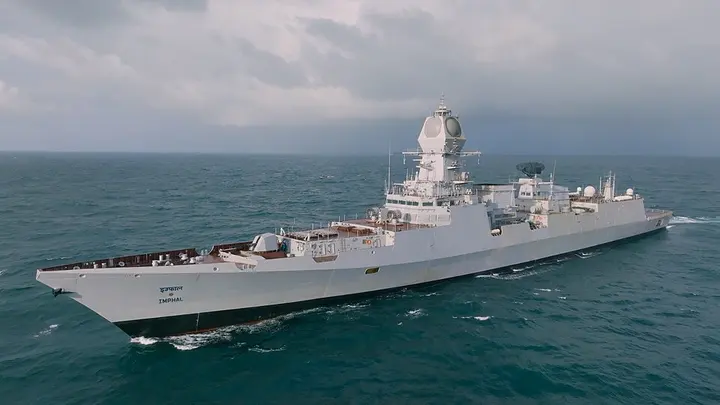
The Indian Navy is working on an extremely ambitious project to modernize its maritime defense fleet. According to a report by The Hindu, the Government of India has granted preliminary in-principle approval to 'Project 18A'. Under this project, next-generation stealth—technology capable of evading radar and sonar—guided-missile destroyers—large warships equipped with precision-targeted missiles—will be built for the Indian Navy.
This new project is being undertaken at a massive financial cost of approximately ₹80,000 crore. This program has received in-principle approval by the Defence Acquisition Council (DAC), chaired by Defence Minister Rajnath Singh. This decision is considered a significant milestone in positioning the Indian Navy strongly against emerging maritime challenges in the Indo-Pacific region.
The new stealth destroyers will be significantly larger in size, possess greater stealth capabilities, and be equipped with state-of-the-art weaponry compared to the principal frontline destroyers currently in the Indian Navy's inventory. In addition to protecting maritime boundaries, these ships will substantially enhance India's capability to project military power across the seas.
- 1. Requirement AssessmentPlanning a next-generation destroyer to combat emerging maritime challenges in the Indo-Pacific region.
- 2. DAC In-Principle ApprovalIn-principle approval of the ₹80,000 crore project by the Council chaired by Defence Minister Rajnath Singh.
- 3. Design and EngineeringDetailed design preparation of advanced stealth technology, radar sensors, and missile launchers.
- 4. Indigenous ShipbuildingPhysical construction of ships and sea trials by Indian shipyards under 'Make in India'.
Historical Context of the Navy and the Need for a Destroyer Class
India's maritime history is extremely ancient, beginning around 2300 BCE with the construction of the world's first tidal dock at Lothal in Gujarat during the Indus Valley Civilization. From the Chola dynasty and the Maratha Navy to the modern Indian Navy, the nation has always emphasized maritime security. Since independence, the Indian Navy has continuously emerged as a 'blue-water navy'—a navy capable of operating efficiently for extended periods in open and deep oceans.
Currently, the Indian Navy's vast fleet includes 2 active aircraft carriers, 13 destroyers, 17 frigates—medium-sized warships, 18 corvettes, and 17 conventional submarines along with 2 ballistic missile submarines. However, keeping in view the changing global geopolitical situations and the increasing activities in the Indian Ocean, the need for large destroyers equipped with advanced technology has arisen.
Project 18A undertaken by the Navy is a step forward from the current Kolkata-class and Visakhapatnam-class destroyers. Compared to older warships, the new destroyers will be able to carry more powerful radars, long-range air defense missiles, and anti-ship missiles.
| Detail / Sector | Statistical Information | Approved Organization / Authority |
|---|---|---|
| Estimated cost of Project 18A | ₹80,000 crores | Defence Acquisition Council (DAC) |
| Committee Chairman | Defence Minister Rajnath Singh | Ministry of Defence |
| Currently active destroyers | 13 ships | Indian Navy |
| Currently active frigates | 17 ships | Indian Navy |
How Project 18A Will Work: The Science of Design and Combat Capability
The success of any stealth destroyer depends on its integrated structural engineering. The main purpose of stealth technology is to reduce the ship's 'radar cross-section'. To achieve this, the ship's outer hull is designed at specific angles so that waves coming from an enemy radar are deflected in other directions rather than bouncing straight back.
In addition, special systems are used to keep the heat (infrared signature) and noise (acoustic signature) emitted by the ship at extremely low levels. A Vertical Launch System (VLS) will be installed on these ships to launch supersonic and hypersonic missiles, enabling the ship to strike in any direction within seconds.
The destroyers will also be equipped with state-of-the-art Active Electronically Scanned Array (AESA) radars, which will be able to track hundreds of aerial and naval targets simultaneously and provide precise data to the missile defense system.
Key Statistics and Financial Investment of Project 18A
Looking at the financial and principal data of Project 18A, this program is one of India's largest budget projects in the defense sector. With a planned expenditure of ₹80,000 crores, this program will give an unprecedented boost to the domestic shipbuilding industry.
The Indian Navy currently operates over 150 ships and submarines, of which 13 major destroyers spearhead the fleet. The new ships to be constructed under Project 18A will be built by Indian shipyards, providing a major boost to the 'Make in India' initiative.
This program will not only enhance the combat capability of the Navy but will also generate thousands of skilled jobs in the domestic supply chain and engineering sector of the Indian defense sector.
જહાજોની સંખ્યા
Indo-Pacific Region and its Significance for India's Security
The Indo-Pacific region, connecting the Indian Ocean and the Pacific Ocean, is critical for global trade and energy supply. A large portion of the world's maritime trade passes through this region, where piracy and geopolitical tensions continue to grow.
These stealth destroyers built under Project 18A will provide the Indian Navy with the capability to patrol over long distances and launch swift military responses when necessary. These ships will further strengthen India's maritime presence from the Arabian Sea to the Strait of Malacca and the South China Sea.
In conclusion, Project 18A is a vital symbol of India's maritime self-reliance and the Navy's policy of providing a protective shield against future maritime challenges.